On Connection
con·nec·tion
/kəˈnekSH(ə)n/
noun
a relationship in which a person, thing, or idea is linked or associated with something else; an arrangement or opportunity for catching a connecting train, bus, aircraft, etc.
What started out as thinking of a serendipitous experience with an elderly gentleman transformed into contemplating the word connection; what is it exactly and is this a term we all can agree warrants a number of musings — and follow-up entries? You’ll see it pop up numerous times here, so let’s get comfortable with it.
Take in the following story with an emphasis on the denotation of connection: “a relationship in which (something) is linked or associated with another.”
Ocean Springs, MS. is a 3rd home to me. New Orleans, LA., you’ll come to learn, is my 2nd. 2 weekends ago, I decided to go exploring and made my way to the Walter Anderson Museum of Art (WAMA) in Ocean Springs, MS. While I’ve been to the Museum and the associated Community Center numerous times and for various reasons, this visit was my absolute favorite.
I stayed about 3.5 hours, and not because it takes that long — instead, as I was arriving, I happened to cross paths with an individual who was ahead of me as we walked in the door. There he was — John, a 90 year young docent at WAMA, who facilitated connections all morning long — between the two of us, me and Walter, me and the pieces of art and — most surprisingly, a connection sparked within myself.
We took in most of the museum together. We talked a lot about the art and discussed some regional and national historical context and cultural and social influences that informed some of the pieces. As we made our way through the galleries, the conversation, like WIA’s work, became more organic, natural, and safe.
I learned that in the 1940s, he was a member of the U.S. Air Force and technical teacher at Keesler Air Force Base, serving as an instructor for air traffic control and weather monitoring for aviation. As our time together went on, he got a bit more personal with his stories and we talked about the 2 years he spent living in Germany with his wife in the 1950s and how when he wasn’t working, they would hop on trains or in the car and be in Switzerland…or Paris…in no time: “it was like a 2 year vacation!” How his face lit up — I’m getting teary considering it now. He was back on a train in those moments — probably holding his wife’s hand — I just know it.
I was a conduit in that moment. I was connecting him with a timespace unique to him.
I’ve written him a postcard and sent it c/o the museum. One of the things we chatted about was how people don’t connect like they used to. I told him he had a “poetic soul” and he just stared at me and I replied:
“it’s ok, I was born at the wrong time. I’m envious of your generation. I think you have a beautifully pointed and gentle soul. It’s a wonderful thing. And it’s wonderful to be spending this time with you. I’m learning so much about things that art should teach us.”
He answered “me, too!”
After that comment, I found he loosened up even more and he started laughing with me about different things. I tried to break away a few times at first, because, as social as I may seem, I often, deep down, feel incredibly awkward around others. Whether it’s accurate or not, I often do not feel a sense of belonging due to lack of shared interest, enthusiasm, and…connection. Then, I realized he really was enjoying me, he wanted to talk about what I was locked in on, and I gave up any desire to end our conversation.
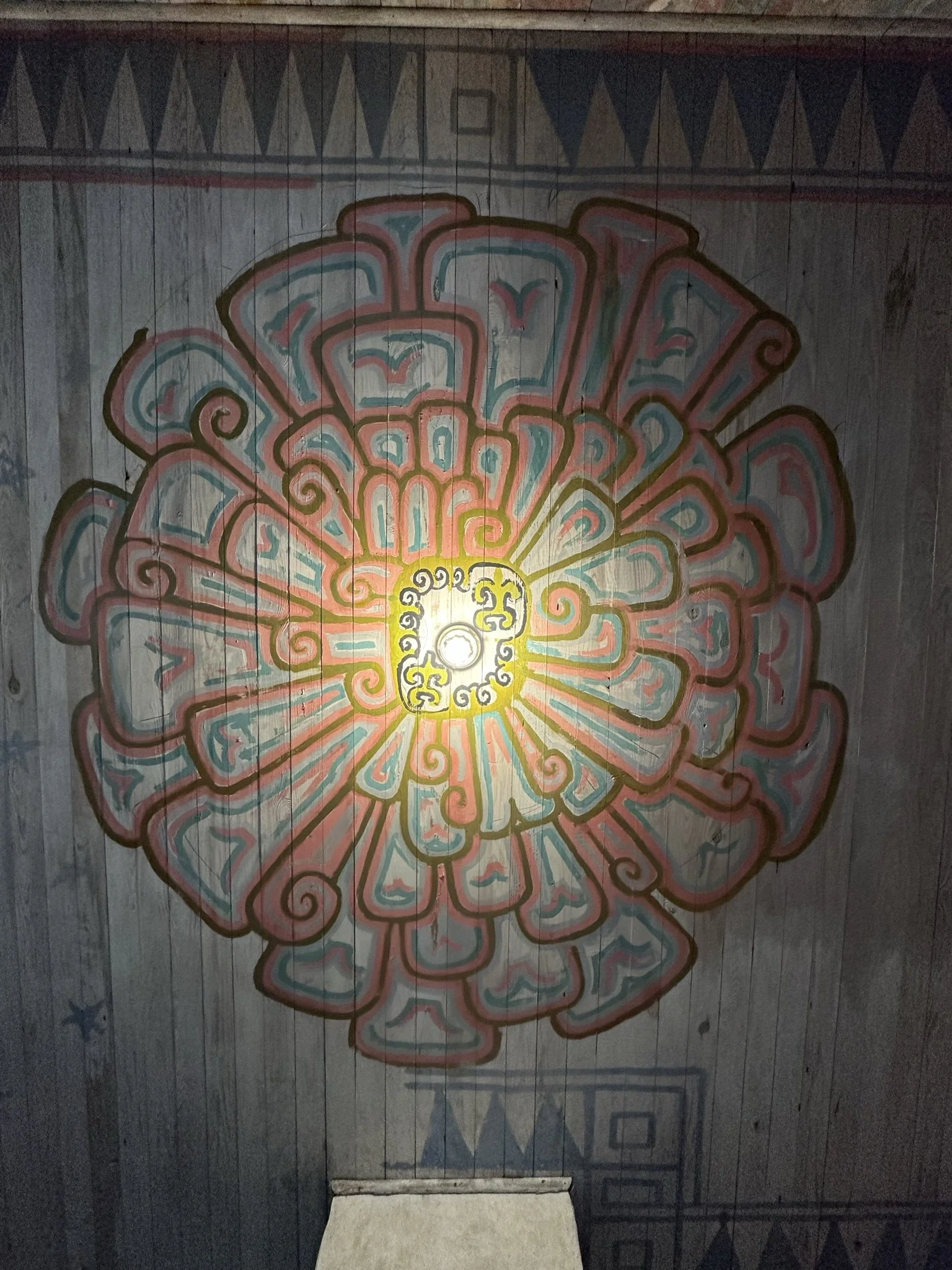
Ceiling view of Walter Inglis Anderson’s studio. Lovingly named “The Little Room.” I see this as an internal light, hidden, in some ways, by the layers and intricacies of the petals but illuminative as it casts beautiful spotlights and shadows as the light flows outwards. Such is life.