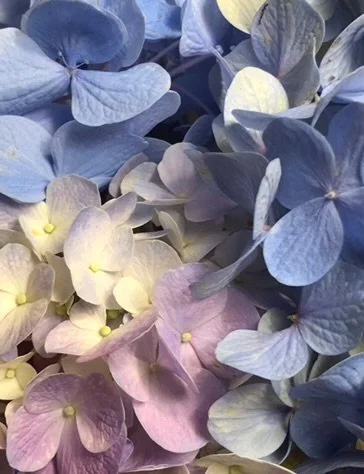
The Language of Flowers: On Alkalinity and Acidity
I grew up surrounded by Southern Living magazines, garden-designing women, and the poetic meaning and restorative power of flowers. I have numerous favorites and let’s kick off exploring them with a perennial powerhouse: hydrangeas. They come in so many different varieties and I would be hard-pressed to tell you which I love most, but I’m willing to cull the list down to my top 3:
French hydrangea (H. macrophylla)
Oakleaf hydrangea (H.quercifolia)
Limelight hydrangea (H. paniculata)
Constellation Garden
Etymologically speaking, the word hydrangea is rooted in two traditions: for the Greeks, it meant water vessel (hydros angos). Which, if you’ve ever enjoyed fresh cut hydrangeas from your garden or brought a bouquet home, you’ll have noticed that they can last an incredible amount of time if you carefully tend to their water supply. If you notice these beauties starting to droop, they can usually be revived by running the stems under hot to lukewarm water and then immersing the petals in room temperature water. Give them an hour or 2 and they’re back to their beautiful selves.
There is some confusion from the French side, some saying that hydrangeas were called hortensia as a nod to Nicole-Reine Hortense Lepaute, the female French astronomer and mathematician. However, the truth turns out to be a little less exciting with the root coming from hortus (garden).
What I hear when I consider the above is the beauty of a constellation garden — and that’s exactly what they look like. Clusters of stars in the French, the staggered pillars of the Oakleaf and Limelights and the spidery starburst limbs of the Fuji Waterfall. They are truly nebulas in bursts of color — pinks, blues, greens, whites, and purples.
When I was young, I remember my grandmother telling me about how to manipulate the colors of French hydrangeas by augmenting the pH of the soil they call home. The lower the pH (acidic), the bluer the flowers (less than or equal to 5.5pH), when the pH is more balanced they will produce purple hues (5.5–6.5pH) and if you want pink flowerheads, try increasing the pH to achieve alkalinity (6.5+pH). Depending on what you’re trying to accomplish, these colors can be achieved by introducing additives to the soil.
Floriography
The Victorians had their Language of Flowers and it became all the rage to send messages to friends, family, lovers, and acquaintances. Symbols, like language, are so very precarious and depending on the culture, messages behind flowers take on various meanings. For this reason, I look to bouquets as a way to conveying messages through flowers — finding corresponding flora to build out your flowering poem.
My favorite tradition informing the cultural significance of the hydrangea originates from Asia where the bloom was first cultivated. If someone gives you a hydrangea under this symbolic tradition, expect it to mean unity — forgiveness and read its simplistic but showy flower amplifies emotions in the purest form. I think this points to the importance of simplicity and directness of Eastern philosophy. Conversely, the Victorians, in all of their excesses, looked at the showy bloom which was produced by few seeds to be an egotistical and boastful bloom.
Sorry, Victorians — you’re wrong!
Poetically, I’ve considered how these beauties mirror human experience in the following piece —
Our lives have moments of
strong acidity
those Blue Periods
that exist in hushed tones,
if given any consideration at all,
engorged on
Sulfur
Gypsum
Magnesium Sulfate.
Modern gurus and their spiritual paths
insist on peace in the
neutralized state
making Pink Ladies of us all,
complacent and reassuring.
To be sure, they refill the
perpetual drip with
dolomite limestone.
Betwixt the blues and the pinks
lies a state of purple
found in the
acceptance,
patience, and
knowledge that
what heals us can limit us and
what ails us can be transformed into an antidote.
When we
intentionally honor our experiences,
it is in this space where we
become balanced.
We become whole.