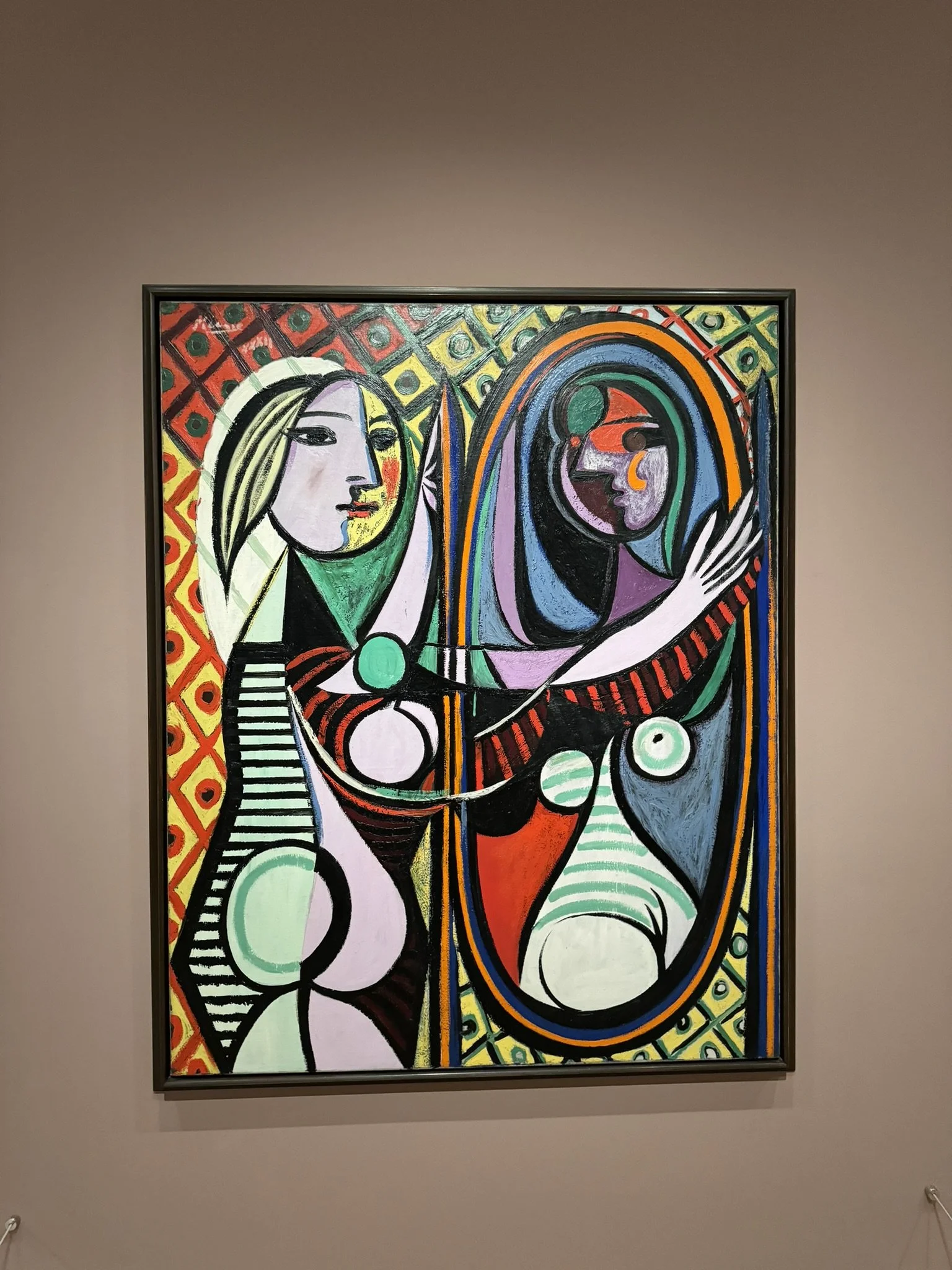
Cubism’s Reflections of the Amorphic Self: Picasso’s Girl Before a Mirror
Inspired by modern sociopolitical and academic developments of the early 1900s, the visual language of the Cubists transcended the canvas and as much as these visual artists were stimulated by modern events and rhetoric, their work was also heavily influenced by intellectual developments concerning the boundaries of physical and psychic experience and existence. These considerations leapt off the canvas and made their way into other artistic endeavors such as literature and architecture, with residual considerations of perspective and experience still present in today’s culture.
Cubism and Amorphism
Pioneered by Pablo Picasso and Georges Braque, Cubism developed into an intellectual and aesthetic exercise in dimensional exploration. Divorced from the linear and exploring the power of space, Cubism offers a geometric consideration and exploration of an objective subject from multiple viewpoints while exposing internal layers. It demonstrates an innate understanding of a subject’s external and internal boundaries through careful deconstructions and subsequent reconstructions.
For the Cubists, creating an economy of meaning between the physical and the psychic realms meant harnessing space, movement, symbols, and fragmentation in an attempt to visualize amorphic concepts in inspiring and intelligible ways. The break from the one-dimensional portraiture of visual and written art harnessed the Cubists’ fascination with, and deeper understanding of, the internal world.
The exploration of the contextual existence, limitations, and secrets hidden within the Self were all tempting consideration to visualize. As such, Psychoanalysis served as a great influence to the Cubists, inspiring contemplation of the psyche, unconscious, and the passage of time from the past morphing to the present and its bleeding to the future.
This begs the question: with the passage of time, does the understanding of a piece of art shift? Is art ever really able to be defined — definitively? As soon as we are able to label the symbols and metaphors an Artist utilizes, individualistic understanding and cultural context shifts, offering a refreshed look at any given piece. Is this not the same relationship we have to the Self? Armed with a deeper understanding through art, do we, over time, shift in our amorphic understanding of the Self to a crystalline understanding?
Considering these nuances, Picasso’s Girl Before a Mirror becomes an intersection of the contemplation of the Self, the shifting in physicalities over time, and the subsequent meaning(s) that flow from the impermanence of our physical and internal worlds. While contemplating the piece, we have to consider the role of Art and the Artist.
What is an Artist?
I’ve likened Artists to a sort of clairvoyant — able to see below the surface and marry invisible nuances, such as emotions, with the physical limitations that bind us in our existence. They see the past, present, and future and they guide us through these visions. In considering Cubism, I’ll add that the Artist becomes a sort of historian, a librarian of the Self. (S)he places the subject within a delicate environment of understanding — asking viewers through symbols, space, perspective, subject/object size (etc.) to interpret the relationship of the subject to a particular timespace — and to bring to the table the individual viewer’s historical and psychological understandings of what the Artist has attempted to harness in this artistic endeavor.
In creating, Artists either destroy or reaffirm. For Picasso, the Artist is:
“…a political being, constantly aware of the heart breaking, passionate, or delightful things that happen in the world, shaping himself completely in their image. Painting is not done to decorate apartments. It is an instrument of war.” — Pablo Picasso
This is a careful word choice in describing art as an instrument of war — not a weapon. Etymologically speaking, instrument comes from the Latin verb instruere meaning to “arrange, prepare, set in order; inform, teach — literally to build, erect.” Art is a mirror, reflecting our deep emotional and cultural cracks and shining back the beauty that we are capable of. Art cannot be weaponized, it can inspire and inform but in and of itself, it is not a weapon. Ultimately, (wo)man becomes the weapon, harnessing (mis)understandings of cultural significance and elevating what is considered “Good Art” to cultural relevance.
Don’t worry — we’ll talk about what “Good Art” is later. What a topic. I’m Wilde (sic) about it.
Fragmentation and the Mask of Re/Oppression
The fragmentation that is evident in Cubism is not only a reverence of African artistic culture, particularly that of ceremonial masks, but also to the idea of the Mask of Re/Oppression that is deeply entrenched in the tradition of Psychoanalysis. The examination of the layers of the Self; the truths/half-truths/lies, our smiles and facial distortions are all reflected in Cubist works. Conscious and subconscious de/reconstruction creates a sort of understanding and meaning of what we find so hard to define. It is only through tinkering, that is, carefully taking apart/categorizing/and re-ordering an object that we grasp the complexity and wonder of existence.
Rhythmic Symmetry and Unique Timespace
Bringing the 2 dimensional to life is not a simplistic endeavor but the Cubists’ ability to achieve this impossibility is made even more remarkable as they harness additional concepts that exist outside of the visual reason: space, movement, and time.
How beautiful is the cradling clock movement that is present in the Girl Before a Mirror?
Look at how Her hand caresses Her reflection while the other gently frames the division between the physical and the reflection? How gentle is the rocking movement from finger tips to chest and the waves gently motioning in the red stripes back and forth?
We are drawn into this stationary painting through soft and rhythmic movement; betwixt the object(s), a complex meaning, understanding, and depth is created. This is my favorite part of this work and it suggests a sort of tenderness, a sort of sweetness that exists between the Girl and Her reflection. However, I am just as apt to tell you that as soon as we are lulled into that comfortable space, the tones of the reflection as well as its expression will lead the viewer down another path —one that is punctuated by misunderstandings, mysticism, and depth.
The space between the Girl and her reflection and the reaching gesture tells me that She is seeking unification of the physical and the shadow Self, to embrace the fullness of Her existence; look at how Her reflection peers at Her knowingly and She gazes back longingly with desire — a desire to understand, a desire to be understood. How vibrant Her reflection is, but do not fail to notice that Her physical body and a little bit behind the mirror, is home to the only light source in this painting:
Perhaps Picasso is asking us to consider what illumination means within the physical and psychological realms.
How curious it is to consider what time means to the Girl. Had I considered this painting at the depth I am now a year ago…or 10 years back…or 5 years in the future, would I describe the same experience?
Is there a sort of time-travel aspect happening in this painting — visiting the past or the future armed with experience and knowledge and also uncertainty and angst? Can we ever really know the complexities of our existence, for our understanding is but one perspective. Does the Girl see a dysmorphia — in age or appearance? Is She proud of what She sees or is She full of goals/plans/regrets? How does She (re)internalize this reflection of Her internal dialogue (monologue)?
With the above considerations in mind, what do you see in the Girl Before a Mirror?